
THE COMPARISON
A fair comparison, at last.
Every tool capital owners already use has a purpose. Here is exactly what each one covers, and the specific gap none of them were built to fill.
THE CURRENT LANDSCAPE
What exists today and what each tool was designed to do.
The tools available to capital owners and portfolio companies each serve a legitimate purpose. The question is not whether they are good tools. The question is whether any of them independently measures the organisational governance conditions that affect enterprise value and reports those findings directly to the capital owner, continuously, across the hold period.
Employee Engagement Surveys
Gallup Q12, Culture Amp, and similar platforms
Captures workforce sentiment effectively, but measures perception rather than how the organisation actually operates.
WHAT THEY DO WELL
Engagement surveys capture how employees feel about their workplace across dimensions like recognition, development, and manager effectiveness. Platforms like Gallup Q12 are backed by decades of validation research across millions of employees. Culture Amp provides customisable surveys with global benchmarking. These tools are effective at identifying workforce sentiment and tracking it over time.
WHAT THEY DO NOT DO
Engagement surveys measure perception, not operating conditions. They capture what people report about their experience, not how the organisation actually makes decisions, handles information, or manages authority. They are designed for HR teams and are administered by management. The capital owner does not receive the results directly, and the data is controlled by the people being assessed.
Board Evaluations
Spencer Stuart, Heidrick and Struggles, Egon Zehnder, Korn Ferry
Strengthens the board itself, but does not reach the governance conditions below it.
WHAT THEY DO WELL
Board evaluation firms bring deep expertise in board composition, director effectiveness, and governance structure. Spencer Stuart has provided board advisory services for over 30 years. Heidrick and Struggles uses proprietary leadership assessment tools. These evaluations help boards improve their own performance through structured self-assessment and facilitated review.
WHAT THEY DO NOT DO
Board evaluations assess the board itself. They do not measure governance conditions below board level, inside the operating business. They do not assess decision velocity across the organisation, verify board pack claims against source data, or measure leadership consensus beyond the boardroom. They are typically conducted annually or less frequently, producing a snapshot rather than a trajectory.
Culture Assessments
McKinsey OHI, Denison, Barrett Values Centre
Maps shared values and norms through self-report, without independent verification.
WHAT THEY DO WELL
Culture assessments provide a structured view of shared values, behaviours, and norms within an organisation. The McKinsey Organisational Health Index benchmarks across a large global dataset. These tools help management understand cultural strengths and weaknesses.
WHAT THEY DO NOT DO
Culture assessments are survey-based and management-commissioned. They measure culture as reported by participants, not as independently observed. They do not verify whether reported conditions match actual operating behaviour. They are typically one-off engagements without re-measurement, and the findings are delivered to management rather than to the capital owner.
Operating Partner Reviews
Internal PE firm capability
Brings deep operational expertise, working entirely from data the business itself provides.
WHAT THEY DO WELL
Operating partners bring industry expertise and deal experience directly into portfolio companies. They work closely with management teams, attend board meetings, and provide hands-on operational guidance. The best operating partners build trusted relationships with CEOs and can influence strategic direction effectively.
WHAT THEY DO NOT DO
Operating partners work from management-provided data. Their governance assessments are based on board meeting observation, CEO conversations, and management reporting. These are valuable inputs, but they share a structural limitation: the information they rely on is controlled by the people being assessed. Operating partners do not use a standardised, quantified governance methodology, do not score dimensions independently, and do not produce trajectory data across the hold.
GRC and Compliance Platforms
Diligent, Protiviti, Centience
Covers regulatory and technology risk, but was not built to measure governance conditions.
WHAT THEY DO WELL
Governance, risk, and compliance platforms provide structured oversight of regulatory compliance, cybersecurity, financial controls, and technology governance. Diligent offers board-level visibility into compliance data. Centience provides portfolio-level technology governance for PE firms. These tools are increasingly important for SEC examination readiness and exit due diligence.
WHAT THEY DO NOT DO
GRC platforms focus on regulatory and technology governance. They do not measure organisational governance conditions such as decision velocity, information fidelity, talent resilience, cross-functional alignment, leadership consensus, or adaptive capacity. They do not deploy diagnosticians inside the business, do not independently observe meetings, and do not verify board pack claims against source data.
Portfolio Monitoring Platforms
iLEVEL, PortfolioIQ, Chronograph
Tracks financial and operational KPIs, without measuring what produces those numbers.
WHAT THEY DO WELL
Portfolio monitoring platforms centralise financial and operational data across multiple portfolio companies. They provide standardised KPI tracking, automated reporting, and benchmarking. PortfolioIQ uses AI-powered data extraction to eliminate manual data entry. These platforms give investment teams real-time visibility into financial performance.
WHAT THEY DO NOT DO
Portfolio monitoring platforms track financial and operational metrics. They do not measure governance conditions. They rely on data provided by the portfolio company or extracted from its systems. The data is management-generated. There is no independent observation, no diagnostician-led assessment, and no measurement of the organisational conditions that produce the financial results.

THE STRUCTURAL DIFFERENCE
What the Friction Index™ does differently.
01
Independence from management
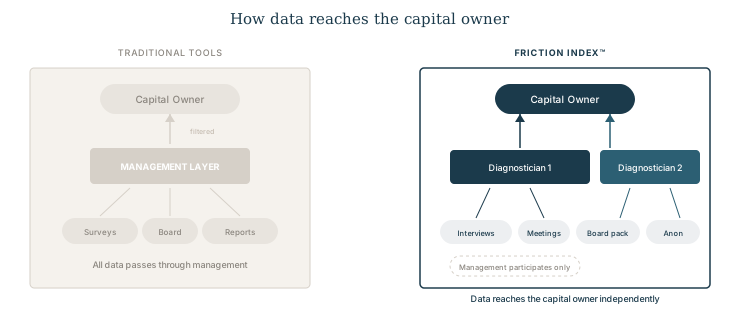
Data is gathered by trained diagnosticians who operate independently. Management participates but does not control what is measured, who is observed, or how findings are reported. Evidence reaches the capital owner through an independent channel.
02
Measures operating conditions, not perception
Six governance dimensions are assessed through direct observation, structured interviews, meeting observation, board pack verification, and leadership assessment exercises. The methodology measures how the organisation actually operates, not how people report that it operates.
03
Built for capital owners, not management
Every design decision follows from a single principle: the system serves the people who own the asset, not the people who run it. Reporting goes to the capital owner. Interventions are accountable to the capital owner. Exit evidence is assembled for the capital owner.
04
Continuous re-measurement
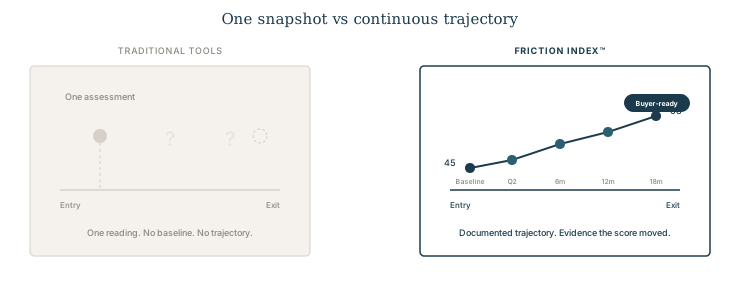
A baseline is established at entry. Dimensions are re-scored at scheduled intervals. Board pack fidelity is audited every quarter. The result is trajectory data across the full hold period. At exit, the governance record contains independently verified evidence spanning the entire ownership period.
05
Codified interventions with re-measurement
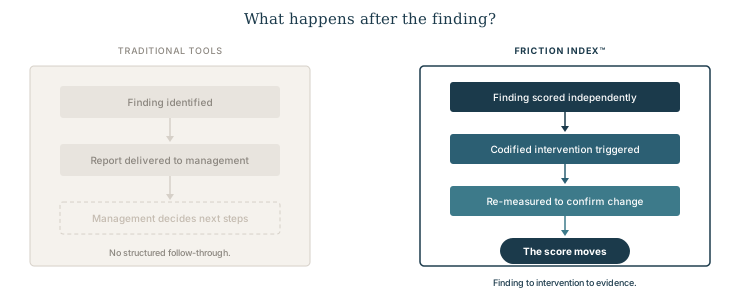
Every finding triggers a specific intervention with an accountable owner and a success measure. Governance conditions are re-measured to confirm whether the intervention worked. This closes the loop between diagnosis and action. The capital owner sees the score move.
AT A GLANCE
How the Friction Index™ compares.
Independent of management
Not addressed by any other tool in this comparison.
Friction Index™
Measures actual operations, not perception
Partially addressed by: Operating Partner Reviews.
Friction Index™
Continuous re-measurement across the hold period
Not addressed by any other tool in this comparison.
Friction Index™
Reports directly to the capital owner
Partially addressed by: GRC Platforms, Portfolio Monitors.
Friction Index™
Codified intervention protocol
Not addressed by any other tool in this comparison.
Friction Index™
Board pack forensic verification
Not addressed by any other tool in this comparison.
Friction Index™
WHAT THIS LOOKS LIKE IN PRACTICE
Three situations capital owners recognise.
The CEO says the leadership team is aligned.
What the board sees and what turns up in exit diligence are not always the same thing.
WITHOUT INDEPENDENT MEASUREMENT
The board observes leadership meetings, sees agreement, and accepts the CEO’s assessment. Two years later, during exit diligence, the buyer’s team interviews each leader independently and discovers the COO and CFO have been operating with fundamentally different strategic priorities. The finding is priced into the deal.
WITH THE FRICTION INDEX™
Each member of the leadership team independently submits their strategic priorities. The results are sealed until all have submitted. The Leadership Consensus dimension reveals that the COO and CFO diverge on three of five priorities. A structured alignment exercise is conducted. By exit, the buyer’s team sees verified alignment data spanning 18 months.
The board pack shows the business is on track.
Reported numbers and verified numbers can diverge quietly for quarters before anyone checks.
WITHOUT INDEPENDENT MEASUREMENT
The quarterly board pack reports revenue growth of 15% and a full talent pipeline. The capital owner accepts the reporting. At exit, the buyer’s diligence team checks the claims and finds actual revenue growth was 11% and two key hires have already tendered resignations.
WITH THE FRICTION INDEX™
The Board Pack Fidelity Audit selects those specific claims and checks them against source data in the quarter they are made. The revenue discrepancy is flagged immediately. The talent pipeline is verified directly. Discrepancies are classified and reported to the capital owner before they compound.
A key leader is carrying the business.
Concentrated knowledge is invisible until the person holding it walks out the door.
WITHOUT INDEPENDENT MEASUREMENT
The capital owner knows the CEO is strong but has not assessed what happens if she leaves. When the CEO resigns, the organisation discovers that critical supplier relationships, pricing authority, and institutional knowledge all lived in her head. The business loses months of momentum.
WITH THE FRICTION INDEX™
The Talent Resilience and Adaptive Capacity dimensions identify the concentration from the first baseline assessment. A Systems Institutionalisation intervention documents critical knowledge and distributes decision authority into a Boundary Charter. When the CEO eventually departs, the transition takes weeks because the capability was already in the system.
Every tool on this page does its job well. None of them was built to independently measure governance and report it straight to the capital owner. That is the one gap the Friction Index™ closes.
If you already hold financial performance to an independent standard, governance deserves the same.
Start a conversation.
No pitch deck. No sales call. Just a conversation about whether Riverbank OS™ fits the asset context.
Organisational governance diagnostics for Private Equity funds and Family Offices.
CONTACT
© 2026 Riverbank Intelligence Pte. Ltd.